


Introduction
Childcare centre development can be a compelling property strategy, but it is not simply another form of commercial construction. The lender is assessing the land, the building, the operator, the lease, local demand, licensing risk and the completed investment value at the same time.
A successful childcare project can benefit from long lease terms, strong population growth, recurring demand and investor appetite for specialised social-infrastructure assets. Where the centre is leased to an experienced operator under a well-structured agreement, the completed property may produce stable income and a clear sale or refinance exit.
However, a project can become difficult to finance if the operator is weak, the rent is unsustainable, local supply is excessive, approvals remain uncertain or the feasibility ignores specialised construction and licensing costs. The lender will therefore look beyond the headline number of approved places. It will examine whether the centre can be completed, licensed, occupied and operated successfully.
This guide explains how childcare centre development finance works in Australia, what lenders assess, how debt is structured, how operator and lease quality affect valuation, which risks most commonly weaken applications and how developers can improve their chances of securing funding.
What is childcare centre development finance?
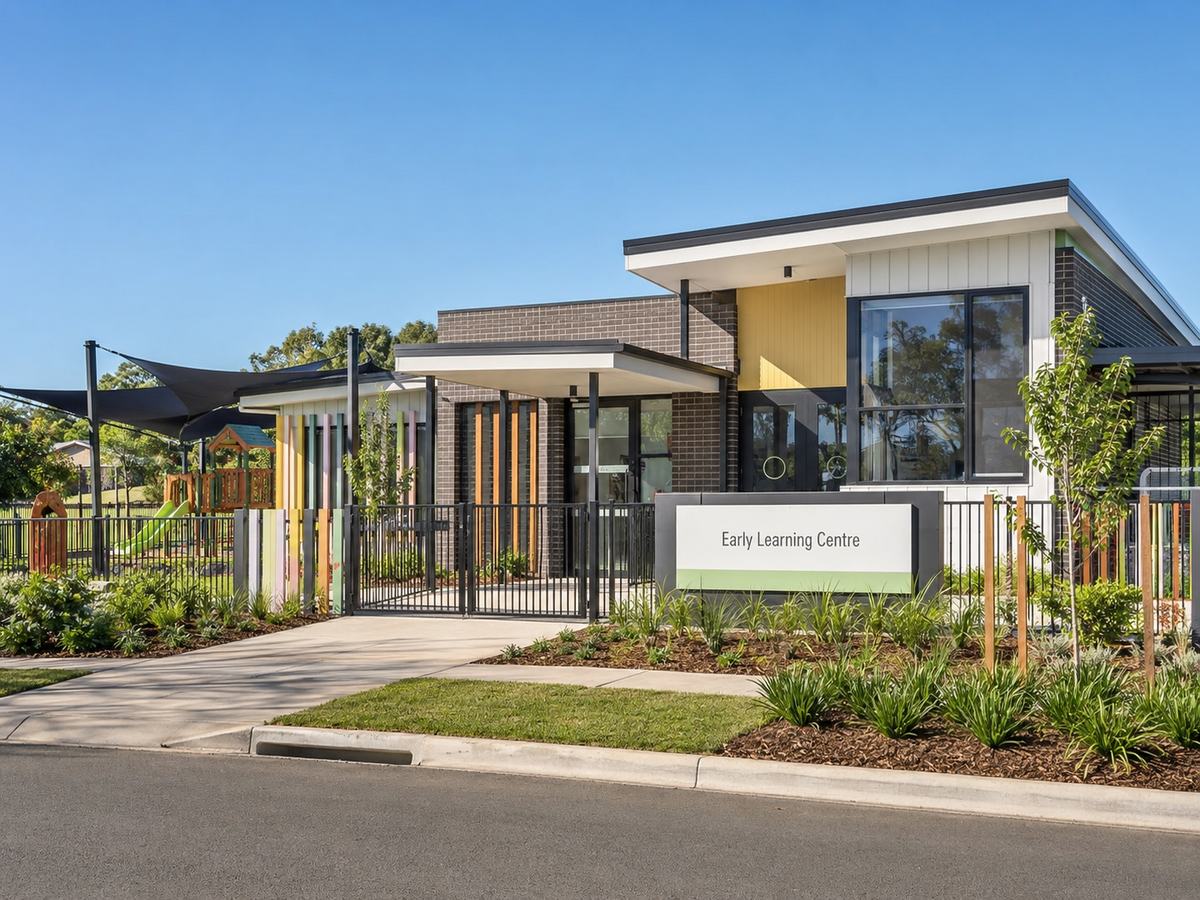
Childcare centre development finance is a form of commercial construction funding used to acquire, develop, refurbish or reposition property for early learning and childcare use.
The facility may fund land acquisition, demolition, civil works, building construction, outdoor play areas, car parking, landscaping, acoustic treatments, professional fees, authority charges, interest and lender costs. Depending on the structure, certain fitout, equipment, business establishment and working-capital costs may sit outside the property development facility.
The finance can be structured as conventional senior debt, higher-leverage private credit, stretch senior funding, senior plus mezzanine finance or a combination of debt and external equity. The appropriate structure depends on the site, planning status, operator, lease, valuation, construction contract, developer experience and intended exit.
A build-to-sell project is commonly funded on the basis that the completed leased asset will be sold to an investor. A build-to-hold project relies on refinance into a long-term investment loan once the centre is complete, licensed and producing rent. An operator-developer may also build the centre for its own business, in which case the lender must assess both property development risk and operating-business risk.
Although childcare development finance is secured against real estate, the quality of the operating proposition is central. The lender needs confidence that the completed centre will be commercially viable, not merely that the building can be constructed.
“An early learning centre is funded on its lease and its licence.”
— The Australian Property Development Handbook
Why childcare developments attract investors
Childcare properties can appeal to investors because they often combine long leases with an essential community service.
A well-located centre may benefit from population growth, workforce participation, new housing development and limited nearby supply. These factors can support stable occupancy and operator demand.
Lease structures are often longer than those seen in conventional retail property, which can provide income certainty. Fixed or indexed rent reviews may also support long-term value growth.
The completed asset can attract private investors, syndicates, property funds and specialist social-infrastructure investors. Where the operator covenant is strong and the rent is sustainable, the investment may be viewed as relatively defensive.
However, the value is highly dependent on the operator and lease. A long lease to a weak or undercapitalised operator is not necessarily more valuable than a shorter lease to an established group. Investors and lenders will examine who is actually responsible for rent, whether guarantees are available and whether the centre can support the rent through realistic occupancy levels.
The land may also have strategic value because suitable childcare sites require the right zoning, access, parking, outdoor space and proximity to families. Sites that satisfy all of these requirements can be difficult to replace.
The main childcare development models
There are several common development models, and each creates a different finance profile.
In a developer-led build-to-sell model, the developer secures the land, obtains approvals, enters into an agreement for lease with an operator, completes construction and sells the leased investment. The lender is focused on development execution and the credibility of the sale exit.
In a build-to-hold model, the developer retains ownership and refinances the construction facility into an investment loan. The completed rent, valuation and debt service coverage must support the refinance.
In an operator-led model, the childcare operator controls the development and intends to trade from the completed centre. This introduces business risk, including occupancy ramp-up, staffing, working capital and licensing. The lender may separate the property facility from the business or equipment funding.
A landowner joint venture may involve the landowner contributing the site while a development partner contributes cash, delivery expertise and guarantees. This can reduce the cash land cost but creates additional legal and governance requirements.
A fund-through arrangement may involve an investor progressively funding the project under an agreed development structure. This can reduce conventional debt, but it requires detailed documentation, strong counterparties and strict completion obligations.
How lenders assess the site
The site is assessed for planning suitability, access, physical efficiency and long-term demand.
The lender will consider the surrounding population, household growth, age profile, employment patterns, nearby schools, transport routes, residential development and competing centres. A strong growth area can support demand, but the lender will still examine how many approved and operating childcare places already exist.
The land must be large enough to accommodate the approved number of children, indoor learning areas, outdoor play space, parking, drop-off movements, landscaping, waste storage and staff facilities. An inefficient site can reduce capacity or increase construction cost.
Traffic and access are important. Childcare centres experience concentrated vehicle movements during morning and afternoon peaks. Poor access, insufficient queuing space or difficult turning movements can create planning and operational problems.
The lender will also consider alternative use value. If the operator withdraws or the childcare use cannot proceed, the value of the land for another permitted purpose becomes important downside protection.
Title restrictions, easements, flooding, noise exposure and neighbouring uses must also be reviewed. A site may be well located but still unsuitable because of environmental or planning constraints.
Planning and approval risk
Childcare developments usually require detailed planning and design approval.
The approval process may address traffic, parking, acoustic impacts, outdoor play areas, landscaping, hours of operation, waste collection, stormwater, fire safety and neighbourhood amenity. Conditions can materially affect both cost and capacity.
A reduction in approved places can change the entire feasibility. The operator’s rent and the investment valuation may have been based on a larger centre, so a planning outcome with fewer places can reduce value even if the building remains viable.
The lender will want to understand which approvals are already in place and which remain outstanding. Funding land before development approval is possible, but it is generally treated as higher-risk pre-development finance with lower leverage.
The developer should also confirm that planning approval, building approval and operational licensing requirements are aligned. A centre can be physically complete but unable to open if regulatory conditions have not been satisfied.
The best funding applications show a clear approval pathway, realistic timing and a costed response to all material conditions.
Talk to BluCow about your project →
The operator is central to the credit decision
The operator is one of the most important components of childcare development finance.
The lender and valuer will assess the operator’s experience, number of existing centres, occupancy performance, financial statements, management capability, staffing systems, compliance history and growth strategy.
A large national operator may provide a strong covenant, but the legal tenant must still be examined. The lease may be signed by a subsidiary or special-purpose entity rather than the parent company. The lender will want to know whether a parent guarantee, bank guarantee or security deposit supports the lease.
A smaller operator may still be acceptable if it has a strong track record, sound financial position and experienced management. However, the lender may adopt a more conservative valuation or require additional security.
The operator’s ability to open and fill the centre is also important. A developer should not assume that demand automatically translates into profitable occupancy. Staffing, reputation, fee levels, local competition and the operator’s marketing capability all affect performance.
Where the developer and operator are related, the lender will examine the relationship carefully. The rent must be commercially sustainable and not simply set at a level that maximises the property valuation.
Agreement for lease and lease structure
The agreement for lease is often a core funding document because it connects the development obligations with the future income stream.
The lender will review the construction standard, approved plans, completion conditions, longstop date, tenant termination rights, fitout responsibilities, incentives, rent commencement and defect obligations.
The document should clearly identify who is responsible for specialised items such as playground equipment, commercial kitchens, security systems, furniture, educational equipment and external works.
The lease term, options and rent reviews affect value. A long lease can be positive, but only if the rent is sustainable and the tenant covenant is acceptable.
The lender will also consider whether the rent begins at practical completion, licensing, occupancy or the first day of operation. A delay between construction completion and rent commencement can create additional interest and holding costs.
If the operator has broad termination rights or the lease remains conditional on matters outside the developer’s control, the lender may not treat it as a secure precommitment.
The agreement for lease, building contract and finance facility must be aligned. The developer should not promise works to the operator that are absent from the construction contract or development budget.
How childcare rents are assessed
Childcare rents are often discussed on a per-place basis, but the lender and valuer will look beyond the headline rate.
The sustainable rent depends on location, centre size, approved places, expected occupancy, daily fees, staffing costs, operator efficiency and local competition.
A high rent per place can increase the apparent investment value, but it may place excessive pressure on the operator. If the valuer considers the rent above market or unsupported by centre economics, the adopted value may be reduced.
The lease may also include turnover components, incentives or stepped rent. These features need to be interpreted carefully when assessing the stabilised income.
Where the developer and operator are related, the rent will be scrutinised more closely. The lender wants evidence that an independent operator could support similar terms.
A realistic rent is more valuable than an aggressive rent that weakens the operator and creates future default risk.
Demand and supply analysis
A strong demand study can materially improve the finance application.
The lender will consider population growth, the number of children in relevant age groups, workforce participation, residential development, nearby employment centres and existing childcare supply.
The analysis should distinguish between approved places and operating places. A large pipeline of approved but unbuilt centres may still represent future competition.
Occupancy at existing centres can provide useful evidence, but it must be interpreted carefully. One successful centre may have a strong brand or waiting list that cannot be replicated easily.
The catchment should reflect actual travel patterns. Families may choose centres near home, work or transport routes, so a simple radius analysis may not capture the real market.
The operator’s own research is important, but independent market evidence can strengthen the submission. The feasibility should also test a slower occupancy ramp-up rather than assuming the centre reaches stabilised occupancy immediately.
“Occupancy is the whole investment case.”
— The Australian Property Development Handbook
Construction and specialised design
Childcare construction includes conventional building work and specialised design requirements.
The project may require acoustic treatments, secure access, shaded outdoor play areas, soft-fall surfaces, landscaping, fencing, nappy-change facilities, commercial kitchens, sleep rooms, staff areas, child-height amenities and detailed safety systems.
The relationship between indoor and outdoor space can affect the approved number of children. Changes during construction can therefore have operational and valuation consequences.
The lender will rely on a quantity surveyor or cost consultant to assess the budget. Specialist items should be supported by detailed pricing, not broad allowances.
Builder experience is important. A contractor may be capable of general commercial construction but unfamiliar with childcare compliance and operator requirements. The lender will examine the builder’s track record, financial capacity, contract terms and subcontractor management.
A fixed-price contract can reduce risk, but exclusions, provisional sums, latent conditions and escalation clauses still need review. The contingency should reflect the design stage and site complexity.
The program must also allow time for inspections, certification, operator fitout and licensing before rent begins.
What costs can be funded?
A childcare development facility may include land, construction, professional fees, authority charges, interest and lender costs.
Outdoor play areas, car parking, landscaping, acoustic works and fixed building services are generally treated as part of the property development cost.
Furniture, toys, educational equipment, software, initial supplies, business establishment costs and working capital may be excluded or funded separately.
Fitout responsibilities must be clearly allocated between developer and operator. If the operator is responsible for equipment but has not secured funding, the centre may be complete but unable to open.
Marketing, recruitment and occupancy ramp-up costs are usually operating-business expenses rather than property costs. An owner-operator needs enough separate liquidity to cover these amounts.
GST timing can also affect cash flow. The developer may require a GST facility or sufficient equity to manage the timing difference.
The funding plan should account for every cost and identify the responsible party. An unexplained funding gap can delay approval or prevent first drawdown.
Key lender metrics
Loan-to-cost measures debt against total development cost and indicates the size of the equity buffer.
Loan-to-value compares debt with the lender’s adopted value. For a leased centre, the completed value is commonly based on the income and capitalisation rate.
Profit on cost measures the projected development profit relative to total development cost. A healthy margin protects against construction increases, delays and valuation softness.
Debt service coverage is important for a refinance exit. The completed rent must support the proposed long-term debt at the lender’s assessment rate.
Debt yield compares net property income with the loan amount and provides another measure of income support.
Cost to complete is monitored during construction. The lender must remain satisfied that undrawn debt and remaining equity are sufficient to complete the building, fitout obligations and approval conditions.
For owner-operators, the lender may also assess business cash flow, occupancy break-even and working-capital requirements.

Valuation of a completed childcare centre
The completed property is generally valued as an income-producing investment.
The valuer considers the rent, lease term, rent review structure, operator covenant, centre size, approved places, location, property condition, market transactions and alternative use.
The capitalisation rate has a major effect on value. A small movement in yield can materially reduce the completed valuation and the amount of debt available.
The valuer may compare rent on a per-place basis, but the adopted value depends on the overall sustainability of the lease.
A centre leased to a strong operator under a long agreement may attract a firmer yield than a centre leased to a small operator with limited financial support.
The valuation can also be affected by lease incentives, stepped rents, related-party arrangements and tenant termination rights.
Developers should prepare their feasibility using conservative valuation assumptions and test the impact of a softer yield.
Running your own numbers?
Open the feasibility calculators →Presales, precommitments and sale exits
Childcare developments do not usually rely on residential-style presales. The equivalent precommitment is generally an executed agreement for lease, a pre-agreed investment sale or a fund-through structure.
A binding lease to a credible operator supports the completed value and demonstrates that the property will produce income.
A pre-agreed sale can reduce exit risk if the purchaser is credible and the contract has limited conditions. The lender will review the deposit, purchase price, longstop date and termination rights.
A fund-through arrangement can provide progressive investor funding, but it introduces documentation and counterparty risk.
Non-binding expressions of interest from operators or buyers provide limited lender comfort. The distinction between genuine commitment and preliminary interest is important.
Senior debt, stretch senior and mezzanine options
A conventional senior development facility generally provides lower-cost funding but requires a larger equity contribution.
Stretch senior funding can increase leverage through one lender and reduce the developer’s cash requirement. This may suit experienced developers with strong projects and sufficient margin to absorb higher finance costs.
A senior-plus-mezzanine structure can achieve similar leverage using two debt layers. The structure is more complex because the lenders must agree on priority, enforcement and cure rights.
Preferred equity or joint-venture equity can reduce the developer’s cash contribution without increasing fixed debt obligations, but it usually involves sharing profit and control.
The best structure depends on the project margin, operator strength, developer experience, liquidity, time frame and exit strategy.
Higher leverage should not be used to compensate for weak demand, uncertain approvals or an unsustainable lease.
Worked example: a leased childcare centre development
Assume a developer acquires a growth-corridor site and secures approval for a 120-place childcare centre. An established operator signs a 15-year lease with options.
The total development cost is $11.5 million, including land, construction, external works, consultant fees, finance costs and contingency.
The commencing annual rent is $900,000. Based on the operator covenant, lease structure and market evidence, the valuer adopts a completed value of $14.6 million.
Under a conventional senior structure, the lender offers $8 million. The developer contributes $3.5 million. The lower leverage provides a larger buffer and reduces finance cost.
Under a stretch senior structure, the lender offers $9.2 million. The developer contributes $2.3 million, preserving $1.2 million of capital. The facility carries higher pricing and requires confidence in the operator, lease and completion program.
The developer must also test the downside case. If the capitalisation rate softens and the completed value falls to $13.5 million, the refinance amount may be lower than expected. The project therefore needs enough equity and flexibility to reduce debt or hold the asset longer.
The correct structure depends on whether the developer values lower finance cost or capital efficiency more highly, and whether the project can comfortably sustain the additional leverage.
Owner-operator projects
Owner-operator projects require a broader credit assessment because the same group is carrying property and business risk.
The lender will assess the development feasibility, but it will also review the operator’s experience, business plan, occupancy assumptions, staffing model, fees, working capital and break-even point.
The centre may take time to reach stabilised occupancy. During this period, the operator must cover wages, utilities, food, insurance, marketing and administration.
The property may be complete and valuable, yet the business can still experience cash-flow pressure. The funding plan must therefore include sufficient working capital outside the construction facility.
Related-party rent should be commercially sustainable. An artificially high rent may increase the property valuation but weaken the operating business.
Separating property ownership from operations can sometimes clarify the funding structure, but the lender will still examine the relationship between the entities.
“The operator covenant does the heavy lifting.”
— The Australian Property Development Handbook
Common reasons childcare finance applications are declined
One common reason is weak operator support. A lease signed by an undercapitalised entity without guarantees may provide limited value.
Another is an unsustainable rent. If the centre economics do not support the proposed rent, the lender or valuer may reduce the completed value.
Oversupply can also weaken the application. A growth suburb may look attractive, but a large pipeline of competing centres can delay occupancy.
Planning uncertainty is another major issue. A project that depends on achieving a certain number of approved places may become unviable if capacity is reduced.
Applications are also declined because construction budgets omit specialist fitout, acoustic works, external areas, tenant incentives or authority conditions.
A first-time developer and first-time operator combination can be particularly difficult to fund. The lender may require more equity, experienced consultants or a stronger partner.
Finally, a refinance exit may fail if the completed rent does not support the assumed investment debt.

How developers can improve financeability
The strongest applications resolve major risks before approaching lenders.
The developer should secure planning approval, complete market research, obtain detailed construction pricing and enter into a robust agreement for lease with a credible operator.
The lease should clearly identify the tenant entity, guarantees, rent, reviews, term, incentives, fitout responsibilities and termination rights.
The feasibility should include all property, fitout, authority and finance costs. It should test slower completion, softer valuation and delayed rent commencement.
The delivery team should demonstrate relevant experience. Where the developer has not completed a childcare centre before, an experienced project manager, builder, childcare consultant and leasing adviser can strengthen the submission.
The exit should be supported by evidence. A sale strategy should refer to comparable investment transactions. A refinance should be tested using conservative debt service assumptions.
The sponsor should also maintain a liquidity reserve. Cost overruns and approval delays can require additional equity at short notice.
Documents lenders typically require
A complete submission usually includes planning approval, approved plans, title information, site survey, market-demand analysis, detailed feasibility, construction program, building contract, quantity-surveyor report and evidence of equity.
The lender will also require the agreement for lease, proposed lease, operator financial information, guarantees, centre portfolio details and occupancy performance where available.
Corporate financial statements, tax returns, asset and liability statements, project experience and details of previous developments are commonly required.
A lender-appointed valuation will assess the site and completed leased investment.
For owner-operators, the lender may request a business plan, occupancy forecast, staffing model, fee assumptions, working-capital budget and management experience.
If external equity, mezzanine debt or a landowner joint venture is involved, the relevant agreements and capital commitments must be disclosed.
Questions to ask before accepting a term sheet
The developer should confirm how the lender defines total development cost, value and equity.
The term sheet should identify whether fitout, outdoor play equipment, tenant incentives, finance costs and GST are included in the facility.
The developer should understand when equity must be contributed and whether land uplift is recognised.
The conditions relating to the operator should be clear. The lender may require an executed lease, bank guarantee, parent guarantee or satisfaction of licensing conditions.
The developer should also review valuation re-test rights, cost-overrun obligations, extension fees, minimum interest, exit fees and default pricing.
For a refinance exit, the lender should explain the assumptions it will apply to rent, interest rates, debt service coverage and maximum LVR.
The true cost of the facility should be assessed in total dollars, not only by comparing annual interest rates.
These principles come from our free guide.
Download the handbook →The future of childcare development
Childcare development will continue to be influenced by population growth, housing delivery, workforce participation and government policy.
Demand may remain strong in many growth areas, but developers must avoid assuming that every new suburb is undersupplied. Supply can increase quickly when multiple approvals are pursued at the same time.
Operators are likely to become more selective about rent, location and centre design. Lenders will continue to focus on sustainable centre economics rather than simply the number of approved places.
Energy efficiency, adaptable design, staff amenity and high-quality outdoor areas may also become more important to operators and investors.
The best sites will remain those with strong demographics, convenient access, limited effective competition and alternative-use value.
Developers who combine property expertise with a realistic understanding of childcare operations will be better positioned to secure finance and deliver durable investment assets.
Frequently asked questions
Can a first-time developer obtain childcare development finance? Yes, but the lender is likely to require a credible operator, experienced consultants, a suitable builder, more equity and a conservative structure.
Does the lender fund furniture and educational equipment? Sometimes, but many lenders treat these as operator or business costs. They may require separate funding.
Is a long lease enough to secure finance? No. The lender will assess the tenant entity, guarantees, rent sustainability, approval status, construction costs and overall project feasibility.
How important is the number of approved places? It is very important because it can affect rent, operator economics and valuation. However, more places do not automatically mean a better project if demand is weak.
Can the project be refinanced after completion? Yes, if the completed valuation, rent, lease and debt service coverage support the proposed investment facility.
Do childcare developments require presales? Not in the residential sense. An executed lease, pre-agreed sale or fund-through arrangement may provide equivalent exit support.
Why can a strong growth suburb still be risky? Multiple competing centres may be planned or under construction, which can slow occupancy and pressure fees.
Conclusion
Childcare centre development finance is specialist commercial funding. The lender must be satisfied that the site is suitable, approvals are secure, construction costs are complete, the operator is credible, the rent is sustainable and the exit is realistic.
The strongest projects combine a well-located site, clear demand, experienced operator, robust lease, detailed construction budget and conservative valuation.
Developers should not view a childcare centre as simply a building with a long lease. The property and the operating business are closely connected. Weak operator economics can ultimately weaken the property value.
Disclaimer
This article provides general information only and does not constitute financial, legal, tax, planning, investment, operational or credit advice. Childcare development finance terms vary between lenders and projects. Developers should obtain advice from appropriately qualified professionals before entering into any transaction.